Translation Workflows

A structured workflow is at the core of an effective translation. In former times, the process of translation was quite linear: source text is read, brief translation drafted, revised, and final output delivered. Today, the workflow has become much more complex, involving teamwork and project management tools.
Modern translation workflows usually consist of a multi-stage process, beginning with translation, followed by review, editing, and element of quality assurance. Among professional practitioners, a vital role is played by the Computer-Assisted Translation tools. These software platforms allow translators to save translations already made in translation memories (TMs), make a consistent use of terminology, and trace changes over time. Structured workflows are not just efficient but also promote accountability while maintaining high standards over large or intricate projects.
Collaborative Translation
In the modern context of translation, collaboration has gained considerable importance. The translator, the editor, and the project manager often work in parallel and use cloud-based systems, allowing instant updates. This system discourages duplication of effort, permitting the input of various experts for creating the final text. Thus, while a translator is focused on language accuracy, technical admissibility is checked by a specialist, and an editor ensures readability and checks consistency in style.
Project Management Integration
Project management software tailored for translation projects makes it easier for you to coordinate timelines, deadlines, and resources. Automated reminders, progress tracking, and presentation dashboards can support various managers across multiple translation projects. The integration of all these features ensures that large translations for international business, legal work, or government documentation must have good but timely and cost-effective delivery standards without losing accuracy on the way.
Quality Assurance in Translation
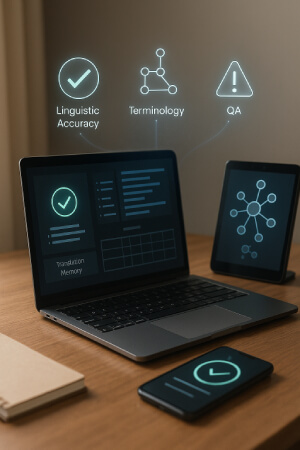
A good translation is not only an accurate selection of lexical items, but it has to be consistent, easy to read and appealing to the cultural context. These are QA processes that ensure that potentials are met and completed satisfactorily.
Linguistic Accuracy
Linguistic accuracy is the quintessence behind professional translation. Indeed, quality translators are to check thoroughly every single point concerning grammar, syntax, and semantic roles for them to be able to carry forward properly at the intended mean. Error whatsoever (however little) can dissipate the professional credibility or even cast a misunderstanding all together. Working along with an expert is a typical way used to maintain quality.
Terminology Management
Introducing a common terminology is important for technical, medical or legal translation. Applications of glossaries and term-bases, which are sometimes available as part of CAT tools, help to maintain consistency across the documents. Organizational terminological standardization underpins an organization's brand and reduces ambiguity for multilingual audiences.
Automated QA Tools
For modern QA processes, a number of tools come with features, including spell-checking, grammar-checking, and consistency-checking. Other tools help identify missing translations, formatting errors or lack of consistency with previous translations. Automation helps efficiency, although human review remains needed to understand context, mood, and nuance, since machines remain semantically challenged.
Corpus Use and Reference Materials
Corpora are tremendously important in modern translation practice as they assist translators in organizing natural and accurate content with language utilization in example, frequency data, and regularity.
Building and Using Corpora
In the case of recurring tasks, translators will use their knowledge and specialized corpora. These corpora will be taken from their previous jobs, internal writings, published work, and past translations. Their aim is not only to provide concordance information that helps them select words, idiomatic patterns, and stylistic alignments but also to simplify the translation process regarding both semantics and the accompanying message intended for the target parties. Consequently, translators need to strike a balance between two pertinent issues, being honest to the source text while ensuring a proper read through words alone.
Reference and Research
In addition to corpora, translators use dictionaries, style guides, and subject-matter reading material. Legal or scientific texts, for example, require accuracy in definition and adherence to formal conventions. Research is a continuous part of this art; translations should be accurate and remain relevant in the context given to it.
Human Expertise and Machine Assistance
The contemporary combination emphasizes interplay between human skills and automation within translation. Machine Translation (MT) goes through large blocks of text much more quickly than could a human, rendering rough translations that are given further detailing by the human touch. This also frees the translator for work on the more nuanced problems and could actuate beyond mere repetition.
Machine Translation and Post-Editing
Machine translation outputs may differ in quality given the language, subject, and system properties. Post-editing by professional translators assures readability, correctness, and style compliance, resulting in a synergy of absolutes of speed and precision that are hard to dream of with human translation alone, most prominently in humongous projects.
Limitations of Automation
Despite making advancements, MT remains fraught with limitations due to contextual problems, idiomatic expressions and humor or cultural jokes. While automation may work for less sensitive or demanding documents, such as price lists or technical manuals, for areas like legal contracts, literary works, or what might pass as a marketing campaign text, such an approach may well lend itself to error or loss of finesse.
Hence, the human attribute has erroneous implications to bridge the gaps, both in terms of the application of human judgment as well as the requisite finesse indispensable to language and impossible for humans to replicate by mere machine intelligence.
Skill Development for Modern Translators

Today's demand for machine-translated work reaches beyond mere bilingual proficiency. With an understanding of culture and earlier modes of exegesis, translators need to be able to assign mental effort from their analytical side. Education becomes critical to instigate change at the professional level, adapting to purposeful implementations that are different from traditional tools, and taking up more quick-learning standards to master new subject matter.
Technical Competence
The expectation of a professional translor has been increasingly broadened into the application of CAT tools, terminology management software, and MT platform aids. If translators are successful in mastering the use of the tools, then they can handle a greater amount of projects while maintaining their quality. Basic understanding of data security, file formats, and collaborative platforms is also a matter of tenet in professional contexts.
Critical Thinking and Problem-Solving
Translation is not a literal word conversion alone; very often, translators must assume the "intended meaning," remove ambiguities, and shape the content for the intended audience. The availability of strong critical thinking skills enables correct judgment in cases where choices present themselves, conferring to the end product in terms of effective communication.
Continuing Education
Professional development by workshops, through certification programs, and through peer networks helps to keep translators up to date. Since translators will benefit from hearing about the new in-linguistic trends and software, awareness of these aspects will become a key feature for Transformation. Thus, anyone who seeks to be part of serious competition in the market needs to find ways to better fulfil undertakings within a dynamically transforming field.
The Enduring Value of Professional Judgment
Science modifies the course of translation practice, but professional judgment remains irreplaceable. The art of aiming for both accuracy and tone, while reverberating cultural considerations throughout the target culture, remains essential for true multilingual communication. No algorithm can ever replace the kind of insights gained by experience and intuition that lead toward vision.
Their professional judgment helps sort through the ethical concerns, matters of confidentiality, and client expectations. With that judgment, the content appears not only right but fit for the target audience, whether it is a legal document, a popular marketing document, or a literary work.
Ethical and Cultural Sensitivity
Today's idea of translation foresees a professional who is culturally knowledgeable, critique-oriented in regionalisms, common norms and audience expectations. Ethics and best business practices in translation are concerned with a transparent and fair relationship towards the author, which again necessitates an environment of trust and professionalism.
Maintaining Quality Standards
It is only natural that certain organizations have quality standards defined to which they must adhere. Standards such as the ISO 17100 lay down the minimum requirement standards for translation, insisting as top priority on consistent quality of service, seasoned professionalism and meticulous attention for the translation procedures. This structured path makes any organization remain professional and responsible, which can, in the end, boost trust among clients.
Translation as a Dynamic Craft
Translation is a marriage of art, science and technology. Today's translation practices exhibit a balancing act between efficiency and human expertise with the interplay of workflows, quality assurance, corpus use, and automation. However, despite the changing tools, the basic skills-the ability to think critically, grasp cultures, and make sound judgment calls-remain the same.
Translators feel they are playing an essential role in more and more rapidly global communication when they can prioritize intra-human operations over the computer-created actions, hooking up a global intraweb of languages to feed off of; translators today get translations done centuries on through time.
Explore Further
Emerging Trends in Modern Machine Translation Using Large Reasoning Models #MachineTranslation #MT #NeuralMachineTranslation #NMT #NLP #NaturalLanguageProcessinghttps://t.co/3Pu9OGELW7 pic.twitter.com/3AoLa7wVqR
— Andres Vilariño 🇪🇦 (@andresvilarino) March 19, 2025
🧵 We’re announcing two new updates to Google Translate to make it easier to connect with people who speak different languages, using the advanced reasoning and multimodal capabilities of Gemini models.
— Google (@Google) August 26, 2025
First: Starting today in the Translate app, you can tap “Live translate”… pic.twitter.com/G1ERT3Y7vR
With the kind support: