The Evolution of Language Technology

Language technology began as an application in language translation and documentation. The early tools were rudimentary, often incorporating dictionaries, rule-based translation engines, or basic work with texts. Today, this technology, integrated with artificial intelligence and natural language processing, has accomplished the unimaginable growth and expansion of language technologies.
Modern systems are capable of translating entire websites, recognizing speech in multiple languages, and assisting writers with grammar, style, and consistency. These tools are the result of decades of research into linguistics, computational theory, and user-centered design. Nowadays, the professionals in translation, content creation, and international business rely heavily upon these solutions in order to change unfortunate workflows, minimize errors, and set the right barometer in communication.
Machine Translation: Breaking Language Barriers
Machine translation (MT) is perhaps the most well-known component of language technology. Using algorithms that convert a piece of text or another language into another, MT allows instant understanding across linguistic boundaries. In its early days, the accuracy of MT began being questioned by producing awkward and unintelligible translations; AI-powered MT models, however, have proved a lifelong savior to all such troubles of the past, sometimes to a great extent.
In the present day, what we refer to as a machine translation is capable of working on complicated sentences, on industrial lexicons, and even on idiomatic utterances; and with remarkable accuracy. The software was found to do wonderfully in combination with content management system (CMS) and a great many collaborative platforms, helping organizations translate multilingually. Machine translation is, in fact, gaining more visibility since it has solved the problem for global entities. Neural system learning enables translation of ideas quickly, but the human mind is still a prerequisite to pick up on the delicate context, sensitivity, and/or ambiguity.
Neural Machine Translation and Its Impact
This format of translating entire sentences at one shot using neural machinery is now crucial in the field of translation. NMT uses deep learning as opposed to rule-based systems, interpreting words and phrases to find the right fit for context, thus generating translations that sound more human. This has been a major advancement in the translation of marketing and technical content.
The use of NMT also lessens time and effort invested in post-editing, hence allowing professionals to focus on higher-level tasks like globalization strategy and content adaptation. Absolute blending of speed, accuracy, and scalability, NMT changes the expectations regarding the realm of machine translation, turning it into the backbone of present-day language workflows.
Customizable Machine Translation for Industry Needs
Modern machine translation platforms oftentimes allow for heavy customization to adapt to the demands of a particular industry or organization. Training your MT engines with domain-specific content like legal contracts, medical records, or technical manuals allows the organization to have infinitely more accurate and contextually appropriate translations. This way, signposting of ambiguities is minimized, and the organizational use of certain terminology is assured consistently across all contents.
Custom MT tools incorporate brands' style and several other guidelines. Developers produce a more efficient, multilingual translation product from a machine translation platform integrated with content management, providing a lucrative context from domain to domain and with little variation according to medium while withholding the quality standards.
Terminology Management Systems: Consistency Across Languages
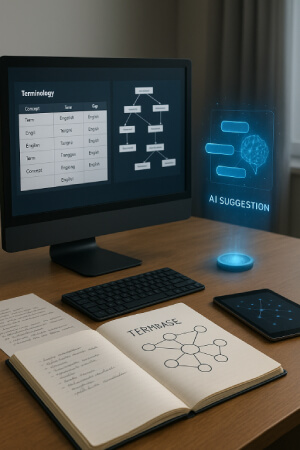
Consistency is key for business communication. Terminology Management System (TMS) keeps the dictionary of the institution standardized across all global languages and thus across each project. They provide linguists, editors, and writers access to previously approved terminology, which helps achieve clarity and minimize the risk of misinterpretation.
Implementing an advanced TMS could prove time-saving by eliminating repetitive research and guesswork. It can also help in enforcing brand integrity, regulatory compliance, and technical accuracy in specialized fields like legal, medical, engineering and finance areas. In addition to simply storing words, modern TMS platforms come equipped with many language technology features to streamline handling of multilingual content in the shape of linguistic search on the one side and recommendation, reference, and integration between translation tools on the other.
The Role of Termbases and Glossaries
Termbases are at the center of terminology management activities. They listen to and maintain all the footprints of approved language in a dedicated way, be it field-related terms, stylistic choices, or anything else for that matter. Allowing the expertise of writers and translators to ensure consistency of message, correct localization of terms, and honoring the cultural peculiarities, this is really a good exercise to refer to.
These tools reduce errors and promote collaboration across teams by offering ready access to well-established terminology. They also facilitate the scalability of translation projects by enabling organizations to maintain a certain level of quality in many languages without concomitant adjustment of costs.
Automated Terminology Suggestions and AI Integration
The newest terminological systems harness the power of AI algorithms to propose terms automatically during translation or writing. Given more exposure to huge-scale applications, they can read a sentence's context and suggest the most fitting term for the particular termbase of the concerned organization, so as to avoid potential incongruities or terms being used wrongly. This facility is, in particular, valuable for big projects and for scenarios where an exclusive human oversight may be insufficient.
AI integration also calls for dynamic vertical updates of termbases for new content and industry-specific terms. Companies are already practicing some degree of semantic analysis; this machinery helps them get quicker quality work. By combining suggestions made by the AI tools with human review, an organization ensures the quality of its work, accelerates workflows, and ensures that its communication is tailored explicitly to the brand or within the regulatory standard.
Voice-to-Text Tools: From Speech to Written Communication

Voice-to-text tools- also known as speech recognition software- convert spoken words into text. For which it may be faster and efficient way to write onto articles. The tools of stenography are tools assisting in operating over workflows through journalism, legal documentation, medical transcription in the necessity, from corporate communications to—quickly dictating ideas and a lot more.
AI-powered voice-to-text platforms are able to recognize accents, meanings, and domain-specific terminology. Ideally, many of such platforms could offer instant transcription that can be used to ease life caption in real-time during symposia, team interaction space, and so on. This kind of interpretation services prevents those who are differently abled from being quite frequently marginalized.
Enhancing Productivity and Accessibility
The integration of general voice-to-text software into various day-to-day tasks is advantageous in that it releases productivity and reduces manual typing and repetitive entry by departments that are very challenged by the inaccessibility of computers and want to dominate a range of professional classes and university events.
Organizations gain more from convenience. Efficient speech recognition promises quicker documentation, improved record management, and strengthened customer interaction. Virtual inter-connection also makes it possible for verbal conversations to be recorded and disseminated easily.
Industry-Specific Applications of Voice-to-Text
Increasingly, the usage of voice-to-text software is being diversified to meet the specific needs of particular sectors. In the healthcare industry, speech recognition can be used basically to transcribe medical documentation properly brain-dead terms and abbreviations. In the legal sector, it can turn court conversations or client interviews into perfect word-for-word written dialogue. Analogously, media and journalism are poised to make a killing by clunkily converting as many interviews and current events as they care to squeak out.
To provide better transcription services to industry-specific linguistic requirements and workflow, organizations must enhance the accuracy and efficiency of the transcription services further. Targeting transcription services help reduce the revenue lost due to the industry-required extensive manual editing, assure compliance with industry stipulations, and net critical information reliably in varied professional surroundings.
Assisted Editing Environments: Precision and Efficiency in Writing
Online writing applications make changes to the spelling, grammar, punctuation, and stylistic correctness suggestions, really altering something regarding the manner in which they may be examined. Thus, such changes serve a purpose by suggesting what is thought to be a good way to write in a certain situation or according to certain organizational standards. These contexts include material within which an author can shape their work, maintain a level of consistency, and adjust the draft content to suit given requirements and fit within distinct places or platforms that from the viewpoints of writers may be valid or not.
However, a human touch still proves useful undoubtedly in today's global business world-for instance, in mu-lingual teams and all that. What these techie chi-chees do is give you language and style suggestions, and even suggestions on terms, which help keep human translation errors in check. They can, on the other hand, help in education and skill development with their feedback and explanations aimed at gradually increasing a writer's level of competency.
Collaborative Editing and Workflow Integration
Thus, many assisted editing environments are meant to work in collaboration with multiple users who work together on the same document, tracking the changes and suggestions as they happen-the integration of the editor with Content Management Systems, translation platforms, and cloud storage makes for a streamlined system.
The mixture of both precision and efficacy modifies the writing process whereby the scope of work at hand would be dealt with faster and without a compromise on quality, even though writing tools allow professionals to deal with more specialized tasks, such as strategic messaging, storytelling, or content grinding, instead of correcting repeated errors.
The Practical Benefits of Language Technology

Across all these tools, machine translation, terminology management, voice-to-text, and assisted editing, language technology provides tangible benefits for professionals and organizations. It accelerates workflows, enhances accuracy, and improves accessibility, all while supporting global communication.
For translators, these tools reduce repetitive work and provide context-aware suggestions that improve translation quality. For writers and editors, they ensure consistency and clarity, whether creating marketing materials, technical manuals, or educational content. For businesses, they enable faster content delivery across multiple languages, helping to reach new markets and audiences without compromising quality.
Efficiency, Accuracy, and Collaboration
The combination of speed, precision, and collaboration is at the heart of language technology's value. Automated processes handle routine tasks, allowing human professionals to focus on creative problem-solving, cultural adaptation, and strategic communication. Collaboration features ensure that teams can work together seamlessly, whether in the same office or across continents.
These benefits also contribute to cost savings. By reducing errors, streamlining processes, and minimizing repetitive work, language technology allows organizations to achieve higher output without proportionally increasing resources. It's a practical investment that strengthens both operational efficiency and communication quality.
The Future of Language Technology
The field of language technology continues to evolve rapidly, with AI and machine learning driving innovation. Future developments are likely to focus on deeper contextual understanding, improved real-time translation, and enhanced support for lesser-studied languages. These advances promise to make communication across cultures even more natural and efficient.
Emerging technologies may also expand accessibility, providing better support for individuals with disabilities or those learning new languages. As these tools become increasingly integrated into daily life, the distinction between human and machine-assisted communication will blur, creating more seamless and inclusive interactions.
Bridging Languages, Enhancing Communication
Language technology for long has been instrumental in helping us get past barriers of geography and knowledge. A variety of technological systems, machine translation, voice-to-text, terminology management, and assisted editing have become instrumental in actualizing faster, more accurate, and more inclusive work among professionals. Such technologies are invaluable for anyone working in multilingual environments, primarily in the realms of transactional matters, creative writing, and academic research.
Explore Further
Emerging Trends in Modern Machine Translation Using Large Reasoning Models #MachineTranslation #MT #NeuralMachineTranslation #NMT #NLP #NaturalLanguageProcessinghttps://t.co/3Pu9OGELW7 pic.twitter.com/3AoLa7wVqR
— Andres Vilariño 🇪🇦 (@andresvilarino) March 19, 2025
🧵 We’re announcing two new updates to Google Translate to make it easier to connect with people who speak different languages, using the advanced reasoning and multimodal capabilities of Gemini models.
— Google (@Google) August 26, 2025
First: Starting today in the Translate app, you can tap “Live translate”… pic.twitter.com/G1ERT3Y7vR